The complex negotiations of the so-called Doha Development Agenda (DDA) seem to have definitively ground to halt at the end of July. Not that progress in the negotiations had ever been particularly fast since 2 November 2001, when they were launched in the Qatar capital. It can hardly be claimed that optimism had ever prevailed over pessimism in the experts assessments throughout this period: the skies over Doha were always decidedly grey and many observers felt that finding a solution to these negotiations was rather like squaring the circle. There are too many conflicting interests, too many chapters still open, and not enough goodwill on the part of the main actors.
Given the importance for the whole world economy of a successful outcome to the negotiations, there was still hope that a virtuous circle could be set in motion by some concessions made – or least announced – by the big members of World Trade Council (WTO), like the European Union or the United States,thus inducing other members to move away from their initial positions.
A development of this kind had been expected and called for over the last five years. But at present a reverse trend seems to prevail. The initial positions have been consolidated and this has led to stalemate.
In 1994, the Uruguay Round ended with the creation of the WTO, a very important new development not only for international trade but also for the whole system of international relations.
In fact replacing the existing General Agreement on Trade and Tariffs (GATT), no longer a treaty, but a full-bodied organisation with coercive powers, thanks to the existence of a system for settling disputes between members ensuring the rules are respected, turned out to be a step forward of great importance for international governance.
Despite the considerable criticism levelled at the WTO, especially from the South of the world and the ‘alterglobal movements, I believe we can objectively claim that progress was actually made and that an international organisation has shown it can make regulations and have them respected. The problem is thus not to reduce the WTO’s powers, as many rather unthinkingly claim, but to flank the WTO’s powers in the trade world with similar powers for multilateral organisations in other fields, such as the environment, social affairs, and energy, in which at present international conventions combine great ambitions with little power.
For example, the United Nations can be widely criticised, but normally this is done on account of its ineffectualness. There can be no doubt that if, in the field of collective security, the United Nations had the same kind of powers created by the WTO, there would be much more chance for peace in the world than with a system still granting some members the right to veto.
Contrary to what is often claimed, the problem is not to have less WTO but rather to have more. In-depth studies have shown that the WTO method for settling disputes is much fairer than is normally believed. Far from being biased in favour of the more powerful countries, it is a thoroughgoing system of rules. Over the years it has worked in favour of more influential members, like the USA and EU, but often it has also favoured other members, opposed to
them.
The jurisprudence of the WTO panel is full of cases won by developing countries over developed countries, and this proves that despite everything in the WTO the rules prevail over the identity of the litigants.
It is thus unfair to describe the WTO as an organisation at the service of the leading players in global trade used to keep all the others in line – a kind of steam roller for globalisation, blind and deaf to the problems of the world.
If anything, the current outlook of the WTO, and it is reflected in the Doha Round, is not so much to balance the way in which disputes are settled, but to define rules encouraging a greater opening up of markets to products from developing countries, especially in the sector of agriculture.
This is the significance of the DDA, and the starting point for analysing the current stalemate.
Like the previous rounds, the Uruguay Round focused on the aspects underlying the creation of GATT: a reduction in industrial tariffs (and duties). This process is almost complete, at least as far as the developed countries are concerned.
They have, however, kept some ‘tariff peaks’ and resort to so-called ‘tariff escalation’ for some products imported from developing countries, and these two exceptions tend to dilute the effects of the almost total abolition of duties.
Making the further reduction in tariffs established by the Uruguay Round acceptable to other WTO members required a reform (beginning in 2000) of the rules on agricultural and services trade, still only in their infancy at the time, especially when compared to other tariff reductions. For many developing countries, the revenue from duty on imported products was a primary source of fiscal income. An indiscriminate reduction in the duties would thus be a serious threat to state budgets and it should be offset by greater opportunities for national products on the markets of developed countries. In the absence of this kind of incentive, it is very difficult to propose speeding up the tariff reduction process to a developing country.
In the case of industrial duties (in WTO jargon NAMA, Non Agricultural Market Access) the commitments made in multilateral contexts concern the so-called bound duties’, normally higher than those actually applied. A WTO member pledges a gradual reduction in duties on most products according to a established schedule (slower for developing countries), but is free to reduce them further following internal trade liberalisation plans (which was the rule almost everywhere in the 1990s).
Emerging countries like India and Brazil, notoriously little inclined to make significant commitments at multilateral level, and which still have duties above the average, can, however, count on a considerable spread between bound rates and applied rates. This means they could fairly easily introduce further reductions in rates.
As we said, the reform of the agricultural and service regimes was to have begun in 2000.
Even before then, the USA and especially the EU had suggested accompanying the revision of the rules with negotiations on other products, to broaden the scope of the negotiations: multilateral rules on investments, competition, and government procurement were seen as indispensable, given the strong correlation between these phenomena and trade (over a fourth of world trade depends on direct investments).
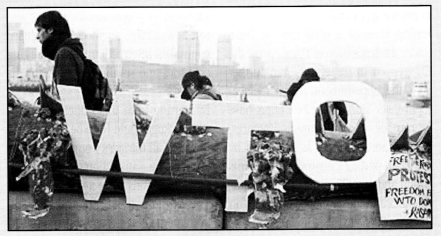
At that time there was talk of the so-called Millennium Round, which disastrously ran aground at Seattle in 2000, when for the first time the WTO became the subject of front page reports because of the mobilisation of nongovernment organisations from many parts of the world protesting against the widening of the trade agenda.
The idea behind the protests was to focus world attention on what was seen as a method for rich countries and international technocrats to impose oppressive rules on poorer countries.
The failure of the Seattle conference was not only a key moment for strengthening the ‘alterglobal’ movements, for which the WTO had become a traditional enemy. It also marked the end of a period in which the big powers, i.e. the USA and the EU, representing forty per cent of world trade, could impose their will on the rules being drafted.
Since Seattle, the transversal alliance between countries in the South and activists in the North has made this dimension utopian, and reaching agreement in the WTO has now become much more complex than it was at the time of the Uruguay Round.
In November 2001 the launching of the Doha Development Agenda was possible only for two reasons: the negotiations were given the priority objective of defining rules aimed at encouraging greater involvement of developing countries in world trade (hence the name) and the aftermath of 9/11 played in favour of this agreement: the new round of trade negotiations was the first great opportunity to introduce more democracy to the world, and make the distribution of resources less unfair (presupposing that international terrorism was really driven by economic injustice, which is far from having been demonstrated).
There were, however, many still unsolved issues at Doha. While at Seattle the aim was to define the parameters for the final agreement of the Round, at Doha there has been a much more modest move to define the starting point for negotiations, postponing the decision on the inclusion or not on the agenda of the so-called Singapore Issues: Investments, Competition, Government Procurement and Trade Facilitation. The EU attaches particular importance to these topics, partly to attenuate the possible impact of the forced opening up of itssown o agricultural markets.
At Cancún in September 2003, a conference originally conceived as an intermediary stage towards the completion of the Round, expected by late 2005, discussions were very heated. Under the leadership of Brazil and India, the new G20 group brought together developing or emerging countries interested in opening up agricultural trade, objectively lagging behind in terms of liberalisation compared to industrial production. They then managed to impose their own line, whereby DDA was primarily to be an agricultural negotiation.
Only one of the Singapore Issues (the trade facilitation measures) has stayed on the agenda, while the others were excluded. Since Cancún it has become obvious that with the waning of the EUUS’s powers of persuasion, highlighted at Seattle, there is now a greater scope for aggregation for developing countries. Thus for example, we have the G20, whose leading members are India, Brazil and South Africa and which is still primarily an agricultural alliance, but also the G90, bringing together the poorer countries which still can’t be described as ’emerging’.
The WTO negotiations are being played out on a very complex multi-dimensional chessboard, involving frequent mini-ministerial meetings (with key members – the EU, USA, Brazil, India and Australia, as well as the WTO Director General and ‘negotiations facilitator’, initially Supachai Panitchpakdi from Thailand, and now the Frenchman Pascal Lamy, former European Commissioner for Trade).
The situation has been further complicated by complex exercises in co-ordination involving the various regional groups and lobbies, in an overall structure with extremely sophisticated variable geometry. At the WTO, an organisation governing very concrete economic interests, the alliances are neither fixed nor ideological, butvariable and a function of the interests at stake in each specific issue.
Thus to speak of all-embracing strategic alliances in the WTO is completely wide of the mark. On certain issues, the USA and the EU can agree (reduction of industrial tariffs in emerging countries and rules on industrial property rights) while on others the EU is far from American positions and nearer to the position of some developing countries (such as products with geographical indications and caution on agricultural reform) but not on others (the elimination of subsidies for farmers). And so on. As we said the ‘chessboard’ has become increasingly complicated thus leading to the arguably inevitable stalemate.
Although the negotiations seemed to have been proclaimed dead at various time in the five-year period, on several occasions hopes were actually rekindled. Such as in July 2004, when the so called Geneva Framework Agreement appeared to provide a platform for re-launching the negotiations.
We can say that since the beginning of this year, the emphasis on the agricultural chapter had meant that the greatest pressure was on the EU, which pays the highest subsidies to its own farmers.
The fact that the EU is at the same time the most generous in terms of opening up its own market to products from less developed countries (the seventy Least Developed Countries, whose products enter with no duties apart from the controversial exceptions of rice, sugar and coffee – products of enormous importance for LDC exporters) and that Brussels has proposed a zero cost cycle for the poorest countries (which would not be a required to make concessions), and also the definitive abolition of distorting subsidies onon exports, has gradually shifted the pressure onto the USA, which has seemed unable, however, in the five years, to provide practical proposals reflecting their frequent free-market pronunciations.
Since 2001, preoccupied with a very different international agenda, the USA has given the impression of not attaching much importance to these negotiations. Even its surprisingly active approach to a bilateral trade agreements – conceived as a prize for more reasonable partners rather than real weddings of interest between equals – and the recent replacement of the chief negotiator (the US Trade Representative) Robert Portman with Susan Schwab would seem to suggest that Washington doesn’t believe in the feasibility of the Doha negotiations. Moreover, the Trade Promotion Authority, allowing President Bush to sign international trade agreements without the ratification of the Senate, will expire in March 2007, and he seems unable, or doesn’t even want, to ask for an extension.
Having invested a good deal at Doha under the leadership of Pacal Lamy, the EU stepped up its efforts even further after the appointment of his replacement Peter Mandelson. New offers have been made on agriculture and services, but they are stillviewed as too modest by the main partners: Australia, the Cairns Group and the G20 as regards agriculture; India and the developed countries on the subject of services.
The two key emerging countries, India and Brazil are in a very special position.
Their strategic influence within the WTO is much greater than their effective trade power. This due to theircapacity to lead the rest of the developing world and the acknowledged skill of their negotiators, among the best in the world (the WTO negotiations require extraordinary technical competence, and every week dozens of pages of extremely complex proposals have to be studied, analysed and answered).
Here we are talking of large emerging economies, but full of contradictions. They are competitive in certain sectors (agriculture in Brazil, and services in India), but lag behind in others. These countries have both gradually reduced their duties, which, however, are still higher than the world average.
Having recently joined the WTO, China has decided not to play an active role, keeping out of the fray and monitoring the negotiations from a distance. China is in no hurry to exercise all of its huge potential, aware that it could further upset the already precarious balances.
Since the Hong Kong Ministerial Conference (December 2005) it has been increasingly clear that such a complex negotiation could not have been concluded through unilateral offers or efforts by one of the sides. Rather a concerted effort is required in which all the various countries are asked to make sacrifices in proportion to their economic power: large sacrifices for developed countries, intermediary for emerging countries and small or nothing for the poorest.
By starting from this principle, a winwin package could have been identified in which all the sides would haven been given some satisfaction, thus making the negotiations more attractive.
This virtuous trend, however, has still not emerged. At the time of the breakdown of negotiations, only a few days after the St Petersburg G7 summit had called for their completion, we can sum up and suggest that the successful solution should come from the combination of a new American proposal to reduce its own internal subsidies to farmers (which strongly influence world prices) and a further European proposal to reduce their own agricultural tariff peaks (the exceptionally high duties on some sensitive products like milk and meat) and a significant reduction in industrial tariffs by Brazil and India.
If all this happened, it could trigger of the virtuous cycle called for by everyone, beginning with the more ambitious proposals for the liberalisation of services. At Hong Kong it was decided that agreement could only reached sector by sector and be ‘plurilateral’, and therefore not include all WTO members (developing countries are not generally inclined to open up their service sector to international competition), but only those actually interested.
Once the big issues have been solved, the new climate could probably lead to the signing of agreements in other fields, such as the definition of measures for simplifying customs procedures (‘trade facilitation’), more transparent shared rules on anti-dumping, the setting up of a multilateral register for the geographical indications of products and so on, all
liable to have positive effects on trade.
But this will probably not happen, at least not in the near future. Everyone expects their neighbour to make the first move, and in this way nobody moves.
Despite the international instability due to terrorism and the rising prices of raw materials, the international economy is enjoying growth, and this has possibly weakened the arguments of those who consider a success at the WTO negotiations to be indispensable.
Moreover, the new complexity of international relations, especially economic relations, in the light of the emergence of the Asian countries and the new variable geometries dominating the WTO suggests that the pause for reflection will be salutary. If the negotiations were to be completed today, the result would be a minor agreement, ultimately of no interest to anyone.
One player who could suffer most, from the point of view of the system rather than economically, is the EU. It draws its international strength above all from its economic and trade influence, where it has clear and proven competence. Hence the importance the EU attaches to strengthening the WTO multilateral system, in which it is a great protagonist.
Any weakening of the multilateral trade system – as is currently emerging – implies less influence for the EU in an area in which it has been particularly strong.
The challenge for the EU after Doha will be to adapt its trade diplomacy to a situation in which bilateral and regional agreements will prevail, thus creating what some have described as the ‘spaghetti bowl’: an enormous number of preferential agreements, incredibly complex to understand and manage.
Keen to extend strong multilateral rules, the EU will not necessarily be penalised by this new situation but it will have to negotiate with greater flexibility (different agreements for different partners – not always easy for the complex European negotiation machinery involving the Council, Commission, Parliament and national political sensibilities, not to mention the increasingly powerful network of civil society).
Paradoxically those who will suffer most from the failure of Doha will be those who should have been the main beneficiaries: the less developed countries. In a complex network of bilateral agreements, who will bother negotiating with them? The emerging economies attract the interest of everyone, those less developed of very few.
Those in the world of social activism, jubilant at the ‘defeat of the WTO’, could do well to ponder this paradox.