At present there is a good deal of talk about a supposed ongoing shift to the left in Latin America. The remarkable coincidence of twelve presidential elections being held in the period from December 2005 to December 2006, not to mention many legislative elections, tends to corroborate the importance of the change, which could effectively radically shift Latin America to the left, especially if there is a swing that way in Mexico and Brazil.
There are several factors apparently adding up to a very significant political change: the recent elections results in Bolivia and Chile, the possible election of the populist Ollanta Humala in Peru, the consolidation of Nestor Kirchner’s position in Argentina, Chávez’s growing influence throughout the subcontinent, the possible success of Lopez Obrador at the head of the PRD in Mexico, and the probable re-election of Lula in Brazil, despite the via crucis his Workers’ Party (PT) has undergone.
In this article we will analyse the similarities and differences in the various situations, seeking to understand if there is really a precise trend in Latin America, or if we are simply witnessing a phenomenon due to the electoral coincidence.
Everything began with the historic election of Lula in 2002. This was the first time that the historic left rose to power in the largest Latin American country – Brazil.
That election was hailed as marking an epoch-making turning point for Brazil and Latin America. After the former union leader had been elected at the first round, the contagious enthusiasm affecting Brazil soon spread to the rest of the world, especially Europe, where the advent of Lula was greeted with – to my mind -rather rash expectations.
While the figure of the patient Lula – elected president at his fourth stab – was being feted, most commentators tended to neglect or even deride the legacy from Fernando Henrique Cardoso’s two terms in office. Those years were hastily written off as a failure. But in actual fact they were a key transition period in Brazilian history. Cardoso’s administration was the first Brazilian government capable of balancing the books, modernising the economy, and boosting growth.
Cardoso’s legacy has emerged clearly in the Lula years: a financially sound and competitive Brazil is acquiring growing stature on the international economic scene. Without Cardoso’s economic austerity, the conditions for Lula’s election would never have been in place. Some observers, however, simplistically tend to attribute the new president with magical powers. Lula is said to have redistributed wealth, eliminated illiteracy and poverty, and changed the course of history for ever.
Clearly the reforms introduced by Cardoso did not yield sufficiently significant results in the social field. But equally, moving the government’s focus for action towards the social world would have been impossible without economic austerity.
Lula has always been aware of this and from the outset he was committed to respecting the agreements with the International Monetary Fund (IMF), subsequently not renewed.
Large sections of the Brazilian left were disillusioned with Lula’s austere approach. He too was written off as being neoliberal, and there was fierce opposition in Brazil from the left during his
term in office.
The greatest disappointment came, however, with the crumbling of the PT, the party of the honest par excellence. It got caught up in a complex mesh of favours, corruption and connivance, reducing its prestige to an all-time low. Once in power the PT turned out to be just like all the other parties. Although the emphasis was shifted towards the social world, their policies did not break with liberal financial orthodoxy, as many both inside and outside Brazil had hoped. The farm reform did not make much progress compared to the previous period and the environment policy (i.e. for Amazonia) was sorely neglected. Some education and health programmes were implemented and then extended successfully. But the Big Bang many had dreamed of in Brazil just did not happen.
With six months to go to the presidential elections, it seems Lula’s personal prestige will be enough to keep him in power. But his second term will be much more complex politically than his first, given that he will no longer have a solid parliamentary majority (this was the issue that gave rise to the scandals, especially the Mensalão scandal).
Has Brazil really moved to the left over the past few years? The left has taken power for the first time, but its scope for action has been structurally limited by the lack of a strong coalition, the need to safeguard economic austerity, the disproportionate expectations created, and the extent of social problems requiring at least a generation of reforms to be solved and not only four years.
Clearly Brazil has set an international benchmark. Lula’s presidency can certainly not be described as a failure while on the international scene the new Brazil has acquired a role unthinkable even a few years ago. Similarly, the new front of emerging countries is a powerful force in terms of international governance.
The enthusiasm surrounding Lula in 2002 has now been echoed in Bolivia with the election of Evo Morales, the new niño bonito of the international left.
This leader of the traditional producers of Bolivian coca is viewed favourably for several reasons: his ethnic origins, his sincere hard talk, his proven capacity to mobilise people, accounting for his electoral success, unprecedented in the complex Bolivian political history, and his ideas for exploiting the Bolivian energy resources for the benefit of the local population.
Since the advent of democracy in Bolivia in 1982, no government has ever managed to give the country stability and implement the right economic and social reforms able to meet the needs of the population and solve the energy equation satisfactorily (see the Sanchez de Lozada crisis and the regional tensions threatening to implode the country).
The crisis in traditional political forms of expression, a feature shared by many Latin American countries, has brought the historical parties to their knees, and encouraged the emergence of the platform of associations and movements, the MAS, which buoyed Morales to electoral success.
We thus come to the first of the similar ongoing developments in Latin America: the traditional parties, expression of the ruling classes, are no longer able to offer convincing prospects. This has happened in Bolivia but also in Peru, where the election of Toledo coincided with the break-up of the traditional parties, except for the social-democratic APRA. It also happened in Venezuela, where Chávism has made the traditional parties irrelevant, but also in Argentina, where radicalism is undergoing a deep crisis and Peronism has split into a left-wing family (Kirchner) and a right-wing family (Duhalde). The phenomenon also partly emerged in Brazil, where the parties have never had strong organisations, except for the PT, but rather electoral cartels. Lula won more votes than his party. He thus was made president by an overall mobilisation that went well beyond the traditional PT electorate. This also happened in Uruguay, where Tabaré Vázquez’s Frente Amplio decreed the end of the traditional blanco-colorado bipolarism.
In Chile the election of the socialist Michelle Bachelet seems to be an exception to the rule, because this is the fourth consecutive election of a representative from the Concertatión. In fact Chilean political history differs from the rest of Latin America, as does its recent economic history. Fifteen years of much higher growth rates than those recorded during the dictatorship, a wide consensus on economics and an open trade policy without precedent worldwide have created a situation in which the concept of left is associated with good economic results.
No one, not even the Chile Communist Party, would now challenge these essential choices. Moreover, they created great difficulties for the right of Piñera and Lavín. A few years ago the rightwingers seemed bound to sweep to victory in this year’s elections after having finally laid the ghost of Pinochet for good.
Although Chile is still a very classbound, socially imbalanced society, the right-left divide hinges more on approaches to the increasingly less urgent political past than any possible different conceptual visions in economics. The challenge for the new Chile government is to share the benefits in the economic growth wider rather than revolutionising the nature of growth. Many countries in Latin America would like to emulate this post-left challenge. Nestor Kirchner’s presidency in Argentina can in a certain sense be labelled as left, even if sui generis. He will almost certainly be re-elected in 2007, given the results in the recent legislative elections. His success is due to the return to institutional stability after a year with five presidents, sound economic growth (nine per cent annually since 2004, albeit following on from the great recession of 2002-2003), and well-managed negotiations with the international creditors. All of these successes were achieved without following the dictates of the International Monetary Fund (IMF).
We must also add some bold choices, although partly steeped in populism, such as reopening court cases from the time of the military dictatorship, and a degree of economic nationalism, which, for example, has even created a crisis in Mercosur.
So I am not sure we can really describe Kirchner as a left-wing president. But he is certainly an unconventional, personalist and populist president who has been able to achieve results, unthinkable even until recently. Moreover, most people have seen their living standards rise, a phenomenon which can hardly displease those who claim to be left wingers.
Chávez’s Venezuela is often cited as an emblematic case of an alternative vision to traditional policies. The Chávez phenomenon is certainly very complex: his populist talk, his ability to reach the poorest sectors of the Venezuelan population and social programmes adopted on a continental-wide scale are certainly anti-establishment. His unbridled personalism, verbal incontinence and militarisation of the economy and politics have raised disquieting questions. Just how far can the Chávez model be replicated?
The Bloque Regional de Poder, the new regional alliance suggested by Chávez as an alternative to traditional models of economic integration opens up interesting prospects for co-operation on energy, trade, and repeating best practices in successful social programmes. I would not go so far as to pompously describe this as the ‘Socialism of the 21st century’ as some do, but I don’t think anyone should be alarmed by the prospect of new forms of South-South international co-operation able to generate closer associations and new prospects.
Of course so far Chávez has been able to rely on the oil manna, enabling him to fuel ambitious dreams and policies at home and elsewhere. Chavism may be interpreted as the latest disguise of Venezuelan oil-based populism. But the real litmus test is the wider distribution of the oil dividends among the population, and any assessments of this can only be made in the future.
If Chávez is successful in this undertaking, I feel that labelling him left or right will be irrelevant. He will simply have achieved a remarkable political result.
Similarly, a president diametrically opposed to Chávez and certainly no leftwinger, Alvaro Uribe, owes his popularity and his certain re-election to the results at times obtained with not wholly orthodox methods – in the struggle against narcoterrorism. Increased security in the Colombian streets, associated with discreet есоnomic results have created an undoubtedly solid platform, leaving little hope for his potential rivals.
Chávez’s populist talk also features in the new phenomenon of Peruvian politics, Ollanta Humala. He seems to be the great favourite in the second round against the eternal candidate Alan Garcia, leader of the APRA.
Ollanta Humala’s programme is fairly unclear, and so far he has only played on his populist message and charisma. His surprising success is once again down to a capacity to communicate with the masses who feel left out of the benefits of economic growth, which was fairly significant in the Toledo years.
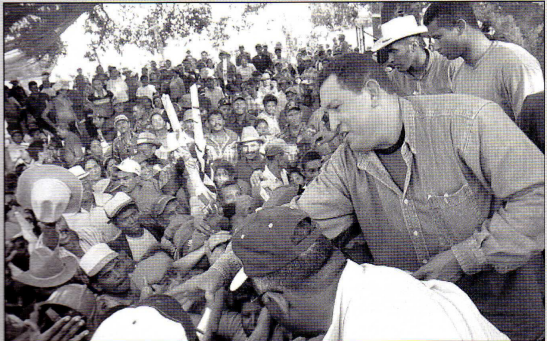
The first Andean president in the subcontinent, Toledo did not lived up to expectations because he failed to implement the necessary political reforms and draw up more effective social policies to the background of economic growth.
Pending Mexican elections in July, when Lopez Obrador’s PRD could take the left to power for the first time (let’s hope the PRI militants don’t hear me, since this party has always claimed to be on the left or a least revolutionary…), what similarities are there between all the cases considered?
The ‘lost decade’ of the 1980s was followed by an age of economic reform in the 1990s focused on balancing public accounts, privatisations, and the modernisation of the economy.
These reforms were not equally successful in each country. Brazil and Mexico were strengthened in the 1990s and their main problem lay in the small social dividends (the very slow elimination of poverty) albeit within a fundamentally sound economic situation. On the other hand, the orthodох approach respecting the IMF recommendations in Argentina was not accompanied by suitable internal reforms. This led to a dramatic economic collapse from which the country only seems to be recovering now.
Chile is the exception. The economic reforms introduced earlier than elsewhere and the open-market model meant that the solutions for social problems – although still insufficient – were managed much better than elsewhere.
The Andean countries were less successful in their economic reforms. Peru obtained the best results, but Ecuador and Bolivia where beset by very complex institutional convulsions, and Venezuela lived off the income from oil. Columbia gave priority to solving the security problem, adopting a model of unilateral cooperation with the United States, making it a unique case in a region now characterised by strong economic nationalism.
The macro-economic financial reforms (labelled as neoliberal by their denigrators) have been more or less successful according to the size of the specific economies. But then at the beginning of the decade the need to focus closer on social problems became more pressing in the whole region.
The second-generation reforms go much further than the strictly economic dimension and concern key issues such as the distribution of wealth, healthcare, education, and the use of energy resources. In one way or another, the new generation of Latin American politicians tends to stress the social dimension of politics, without neglecting economic austerity but no longer attaching an almost religious value to the formulas of the Bretton Woods organisations.
The new leaders tend to go beyond traditional party politics, in crisis everywhere, especially the left-wing parties, and develop a direct dialogue with the people. Often they become charismatic leaders with their own personal credibility, which is much more than the specific weight of the political areas supporting them.
In the international field, the Latin American countries have overcome their traditional acquiescence to the United States, whose interest in the region, moreover, has waned drastically since 9/11. They now flaunt economic independence in the international context (the emergence of the G-20 bloc at the World Trade Organisation, the standstill of FTAA negotiations biased in favour of the North American countries, and redrafting the rules of the game for energy).
Can all of this be described as being the outcome of left-wing policies? Once again what counts least are labels and generalisations. Latin America needed to tidy up its housekeeping and it did so at times painfully – in the 1990s. Then when the need to share out the benefits from economic growth more equally came forcefully to the fore, traditional politics was unable to manage this new dimension and was superseded by new, more direct and charismatic forms of political expression. At times this took place in the context of the old organised parties (e.g. Brazil and Argentina) but more often in new aggregations more in tune with popular sentiment. In the Andean countries, the new political phase has often assumed indigenist tones.
What direction is Latin America moving in? Like the analysis of the phenomenon, the answer to this question cannot be unequivocal. We are certainly in the presence of processes forging new forms of conceiving and managing politics, verging on both populism and a new humanism. This approach to politics responds more effectively than the classic liberal model to the problems of the complex countries in Latin America.
It is crucial, however, that this new humanism does not undermine the basic rules of economics. Growth is an indispensable premise for countries with a pyramid-shaped social structure like those in Latin America. The irresponsible approach leading to the debt crisis in the 1980s and generating greater poverty completely failed to alter the pyramid structure.
Take, for example, the energy issue in Bolivia. This is no longer a question of ‘kicking out’ the foreign investors, indispensable both from the technological and financial points of view, but of renegotiating in a more balanced way the long-term agreements providing certainties for both sides and allowing for a more balanced distribution of the benefits of resources. This ‘left-wing’ objective should be in everyone’s interest, even that of the international companies.
The world has changed greatly over the last decade. The emergence of new Asian economic powers is self-evident. Latin America is integrating into the new international balances in a more varied and certainly less forceful way. But the new developments in Latin America over the last few years could turn out to be very significant and create an example to be followed in other parts of the world.